so, a tourist came into the cafe the other day.
not that this is unusual, but anyway.
he asks the usual questions (where are you from? is this your cafe? how long has it been open? etc, etc) and goes about enjoying his cafe au lait.
meanwhile, it starts to pour down rain. i'm talking like rainin' sideways type lashing rain.
it was still august then -- and hiroshima has gotten 3 times its usual amount of rain. we had all of two sunny days last month, no joke.
i'm looking out the windows at the head of the cafe and scowling. business gets slow when it rains like the world is going to end.
tourist boy notices and casually asks what there is to do in hiroshima on a rainy day.
"what indeed," i replied, and went to rattle off a list of stuff to do in the rain. it was a short list, but i digress. the tourist taps some stuff into his ipad, nodding every now and again at my explanation of landmarks, before he asks,
"do you know any good places to eat for traditional..."
traditional japanese food, my brain finishes, immediately pulling up kaiseki (super traditional japanese lunch/dinner courses) restaurants and places to get good, authentic japanese food. i've got like 6 mental tabs open by the time he finishes saying the word "traditional" and moves onto the next word.
"oh, oko&$#@%&-yaki?"
okonomiyaki?!
my eyes must've bugged out.
okonomiyaki is a local hiroshima dish (okay, they have it in osaka too, but that's osaka-style, it doesn't count), but it's just not something that ever struck me as being traditional. i mean, i guess it is? because it's been around for ling enough, but it's not. it's b-kyuu gurume which basically means like cheap, everyday foods. you'd never hear okonomiyaki described as "traditional" --- it'd be like calling grilled cheese or PBJ a "traditional american sandwich".
y'see what i mean?
can food be considered traditional even?
does that even make sense?
classic, sure i can see that, but traditional?
you got me there.
2014年9月4日木曜日

2014年9月2日火曜日

2014年8月29日金曜日

matsuri (episode 1)
matsuri【祭り】
hiroshima has a good number of matsuri throughout the year. these lively events have less to do with the god or godlike being that the festival is held for, and more to do with the gathering of the community and having a good time, eating yatai food and wearing yukata or dancing the bon dance.
here are some local and prefectual-wide festivals in hiroshima city:

 lots of yatai, which are street vendors that sell everything from food to toys to goldfish. we got some takoyaki (octopus dumplings?) and some taiyaki (fish shaped cakes with anko in the middle), which are standard fare for any matsuri. the place is milling with locals enjoying a beer and chatting with neighbors and friends.


mmm...octopus.

there's an altar with candles and incense surrounding a jizou statue. often translated as the "guardian deity of children", these jizou statues are often built at the site of tragic accidents or for stillborn children. they are also placed at city or village limits to protect the land and its inhabitants.
since i wasn't sure the implications of taking a picture of a jizou statue while a festival was being held in its honour, i didn't take a picture, but here's one i found on the web of a typical jizou statue.

(they almost always have red bibs around their necks)
next to the jizou statue was a stage where lots of different events were being held. high school bands, bingo games, and kagura, which is a type of "shinto theatrical dance" (thanks wiki!). basically, ancient myths and folklore are acted out using song, dance, and dialogue with ridiculously elaborate costumes and flashy movement. the music is all traditional japanese instruments -- high pitched flutes and drums of all ranges, working together at fever pitch during the intense fight scenes, or quietly giving rhythm to the performers' speech...not like i could understand the bulk of what was being said since it's in like old-school japanese, but that's beside the point. the point is, it's hella entertaining -- this was actually my first time seeing live kagura and i have to say, i was enchanted. there are still lots of kagura-dan or kagura groups that are active in northern hiroshima and shimane prefecture (just north of hiroshima prefecture), and if given the chance, i would LOVE to see another performance.

what struck me most about this festival was the sheer locality of it. kawahara-machi is by no means a huge part of the city. there were likely 50 people there, at best, and all of them residents of the area. parents talking to parents while kids run about with plastic masks or glow sticks, elderly residents watching kagura with their grandkids, middle school girls moving in herds while snacking on kara-age (fried chicken)... it's just a great way to unite the community, if only for two days, and a great excuse to go outside and enjoy the (relative) cool of summer nights in hiroshima.
hiroshima has a good number of matsuri throughout the year. these lively events have less to do with the god or godlike being that the festival is held for, and more to do with the gathering of the community and having a good time, eating yatai food and wearing yukata or dancing the bon dance.
here are some local and prefectual-wide festivals in hiroshima city:
ebisu-kou 【えびす講】
touka-san 【とうかさん】
flower festival 【フラワーフェスティバル】
zenzai matsuri 【ぜんざい祭り】
sorasaya-inari jinja matsuri 【空鞘稲荷神社祭り】
kawahara-machi jizou-son【河原町地蔵尊】
there are likely more, and i also don't have all the proper names, but these are the main matsuri going down in hiroshima city and in the dobashi/tokaichi area (where i happen to be centered).
today we'll be looking at the kawahara-machi jizou-son matsuri, held in late august.
summer festivals are great -- bon dancing and yatai under the chouchin (paper lantern) light.
we were apparently too late for the bon dance -- which is a simple dance that involves moving around in a circle around a large tower-thing where taiko drums are being played. was looking forward to getting some pictures, but alas. summer festivals are also great places to wear yukata (light summer kimono), and i did see some people dressed in them here. but then again, this is a really small festival, taking up maybe 3 blocks of the street for the weekend. here's a look at the main road:
there are likely more, and i also don't have all the proper names, but these are the main matsuri going down in hiroshima city and in the dobashi/tokaichi area (where i happen to be centered).
today we'll be looking at the kawahara-machi jizou-son matsuri, held in late august.
summer festivals are great -- bon dancing and yatai under the chouchin (paper lantern) light.
we were apparently too late for the bon dance -- which is a simple dance that involves moving around in a circle around a large tower-thing where taiko drums are being played. was looking forward to getting some pictures, but alas. summer festivals are also great places to wear yukata (light summer kimono), and i did see some people dressed in them here. but then again, this is a really small festival, taking up maybe 3 blocks of the street for the weekend. here's a look at the main road:


there's an altar with candles and incense surrounding a jizou statue. often translated as the "guardian deity of children", these jizou statues are often built at the site of tragic accidents or for stillborn children. they are also placed at city or village limits to protect the land and its inhabitants.
since i wasn't sure the implications of taking a picture of a jizou statue while a festival was being held in its honour, i didn't take a picture, but here's one i found on the web of a typical jizou statue.
(they almost always have red bibs around their necks)
next to the jizou statue was a stage where lots of different events were being held. high school bands, bingo games, and kagura, which is a type of "shinto theatrical dance" (thanks wiki!). basically, ancient myths and folklore are acted out using song, dance, and dialogue with ridiculously elaborate costumes and flashy movement. the music is all traditional japanese instruments -- high pitched flutes and drums of all ranges, working together at fever pitch during the intense fight scenes, or quietly giving rhythm to the performers' speech...not like i could understand the bulk of what was being said since it's in like old-school japanese, but that's beside the point. the point is, it's hella entertaining -- this was actually my first time seeing live kagura and i have to say, i was enchanted. there are still lots of kagura-dan or kagura groups that are active in northern hiroshima and shimane prefecture (just north of hiroshima prefecture), and if given the chance, i would LOVE to see another performance.

what struck me most about this festival was the sheer locality of it. kawahara-machi is by no means a huge part of the city. there were likely 50 people there, at best, and all of them residents of the area. parents talking to parents while kids run about with plastic masks or glow sticks, elderly residents watching kagura with their grandkids, middle school girls moving in herds while snacking on kara-age (fried chicken)... it's just a great way to unite the community, if only for two days, and a great excuse to go outside and enjoy the (relative) cool of summer nights in hiroshima.
quirky japan (episode 1)
one of japan's big tourism catchphrases, or "catch copy" as they say here, is "cool japan" ...
yeah, WOW, give that guy a promotion for creativity, right?
i'm not saying that japan isn't cool, because it is. i mean, c'mon, cellphone service companies building talking robots for sale? frickkin' cool.
but i've got a better catchphrase that really captures japan's essence --
quirky japan
that's right my friends, japan is a quirky place. endearingly quirky, annoyingly quirky, maddeningly quirky -- it's got its quirky bases covered.
you could easily write an ENTIRE blog focused solely on japan's quirks -- but i'm just going to write them as i think of them. and today, i present to you one of the annoying quirks---
the four seasons quirk
if you're ever in japan for longer than say...a week...inevitably you're going to encounter the following phrase, be it on TV or someone on the street or passing conversation:
「日本には四季がある!」
nihon ni wa shiki ga aru!
translation: they have four seasons in japan!
...uh...
duh?
i dunno, i always thought that NOT having four seasons was more an exception than the rule. i mean, i know there are indeed countries that don't have four seasons, but... is it really so unique to have a spring, summer, fall, and winter?
you'll be told about japan's four seasons like it's some great enlightening secret.
DUDE, FOUR SEASONS. FOUR DIFFERENT SEASONS. IS YOUR MIND BLOWN?!
...nope. why do you think they have words for these mystical four seasons in (likely) most every language?
*whispers* that's because most everyone has four seasons on the planet.
japan LOVES the seasons -- i don't blame them, i like them too! i'm not hating on the seasons, i'm just baffled as to why they feel the need to tell foreigners about them because we obviously don't know (even though most of us do).
japan does indeed have a long history of using seasonal icons in poetry, letters, art... like cherry blossoms in the spring, hydrangeas during the rainy season, maple leaves in the fall, etc, and that's all well and good. in fact, i think it's great to celebrate and appreciate the seasons (even if they have gotten a little weird in recent years).
but it's just a little silly to go around with a figurative banner proclaiming to the masses that OMG JAPAN HAS FOUR SEASONS GUYZ~!
it's okay, japan. you can put away the banner, go on. the secret's out.
yeah, WOW, give that guy a promotion for creativity, right?
i'm not saying that japan isn't cool, because it is. i mean, c'mon, cellphone service companies building talking robots for sale? frickkin' cool.
but i've got a better catchphrase that really captures japan's essence --
quirky japan
that's right my friends, japan is a quirky place. endearingly quirky, annoyingly quirky, maddeningly quirky -- it's got its quirky bases covered.
you could easily write an ENTIRE blog focused solely on japan's quirks -- but i'm just going to write them as i think of them. and today, i present to you one of the annoying quirks---
the four seasons quirk
if you're ever in japan for longer than say...a week...inevitably you're going to encounter the following phrase, be it on TV or someone on the street or passing conversation:
「日本には四季がある!」
nihon ni wa shiki ga aru!
translation: they have four seasons in japan!
...uh...
duh?
i dunno, i always thought that NOT having four seasons was more an exception than the rule. i mean, i know there are indeed countries that don't have four seasons, but... is it really so unique to have a spring, summer, fall, and winter?
you'll be told about japan's four seasons like it's some great enlightening secret.
DUDE, FOUR SEASONS. FOUR DIFFERENT SEASONS. IS YOUR MIND BLOWN?!
...nope. why do you think they have words for these mystical four seasons in (likely) most every language?
*whispers* that's because most everyone has four seasons on the planet.
japan LOVES the seasons -- i don't blame them, i like them too! i'm not hating on the seasons, i'm just baffled as to why they feel the need to tell foreigners about them because we obviously don't know (even though most of us do).
japan does indeed have a long history of using seasonal icons in poetry, letters, art... like cherry blossoms in the spring, hydrangeas during the rainy season, maple leaves in the fall, etc, and that's all well and good. in fact, i think it's great to celebrate and appreciate the seasons (even if they have gotten a little weird in recent years).
but it's just a little silly to go around with a figurative banner proclaiming to the masses that OMG JAPAN HAS FOUR SEASONS GUYZ~!
it's okay, japan. you can put away the banner, go on. the secret's out.
2014年8月27日水曜日
review: le triskel
yesterday was my birthday and also 5 year wedding anniversary. yay!
as such, husband made reservations at le triskel, a french restaurant listed in the hiroshima michelin guide (listed, not rated). i'd seen the place before and had had my eye on it, but completely forgot until we actually arrived.

it's on the second floor of an old building in nobori-machi. the interior is well-lit with about 5~6 tables. lunch is course only (i think there were 3 courses to choose from, varying in price) -- he reserved the gourmand course, ranging from amuse bouche to dessert. here's the run-down.
amuse bouche
foie gras crème brûlée

beneath a crunchy layer of bittersweet burnt sugar lies a thick, yet light foie gras mousse. the combination of sugar and salt was great -- it was unlike anything i've tasted to date, that's for sure. there was also a hint of rum in the mousse, which just added to the overall taste experience.
second course (salad)
kadaif-wrapped hamo (daggertooth pike conger... what?) with zucchini fondant and red pepper sauce

hamo is a popular...fish? conger? ingredient. to use in the summer in japan. it's very much like a light white fish in texture, melting in your mouth. by wrapping it in crunchy kadaif, it gives a kick to the hamo in the texture department. the vegetables in this salad are local and very flavourful -- they're also kept as raw as possible, even the kabocha squash is raw (which i haven't had before -- crunchy!). really goes to show you how much faith they have in their vegetables. the zucchini fondant was also a first for me -- it was light, like a mousse, and captured the flavor of zucchini along with vegetable stock to give it a slightly salty punch. the sweet red pepper sauce and extra-virgin olive oil drizzled alongside brought a refreshing sweetness to the whole salad.
third course (fish)


komatsuna or "japanese mustard spinach" is a leafy green vegetable that i kinda associated with having a bitter taste. so i was a little wary of the rich green sauce -- but of course, i was wrong. but first, beef cheeks!
beef cheeks, or hoho-niku, are one of my favorite cuts of beef. admittedly, it's a pain in the ass to prepare since you have to stew it for a long time to make it tender and delicious, but when it's done right (and it was), it's just gorgeous. thick cut and tender, you could cut it in half using your fork -- no need for knives with this little beauty -- the meat was so tender it was practically falling off by itself. the sweetness of the red wine paired with a salty tones of the komatsuna sauce brought out the best in each other and i've hardly chewed the meat before it practically dissolves in my mouth.
the vegetables paired with the meat (broccoli, golden potato, red onion, toumyou or green pea sprouts) are all local grown and packed with flavor. toumyou has that earthy bean taste without being astringent, the broccoli was brilliantly and decidedly green in flavour, and the red onion was roasted perfectly, bringing its own sweetness to the plate. and that potato -- fried until slightly crisp with its own mild sweetness -- it went exceptionally with the sauce.
it was a meat lover's dream and a vegetable lover's dream at the same time.
fifth course (dessert)
terrine chocolat with mango sorbet and fresh fruits

because it was my birthday, they made a special dessert plate for me. brought out on a chilled stone plate, the first thing that catches your eye is that vibrant golden mango sorbet. underneath is terrine chocolat, which is like a rich and dense chocolate mousse. the intense sweetness of the mango sorbet (it was like eating mango puree, in a good way) accented the rich milky chocolate, and the raspberry sauce underneath it all provided just the right amount of sanmi ("acidic sourness" -- sourness?) to complement the sweetness.
they also wrote "bon anniversaire" on the plate in chocolate <3
an excellent and carefully prepared course using local ingredients well-deserving of its price.
i don't know what more you can ask for.
--------------------------------------------------------
le triskel
nobori-machi 5-7
naka-ku, hiroshima-shi
082-511-5031
as such, husband made reservations at le triskel, a french restaurant listed in the hiroshima michelin guide (listed, not rated). i'd seen the place before and had had my eye on it, but completely forgot until we actually arrived.

it's on the second floor of an old building in nobori-machi. the interior is well-lit with about 5~6 tables. lunch is course only (i think there were 3 courses to choose from, varying in price) -- he reserved the gourmand course, ranging from amuse bouche to dessert. here's the run-down.
amuse bouche
foie gras crème brûlée

beneath a crunchy layer of bittersweet burnt sugar lies a thick, yet light foie gras mousse. the combination of sugar and salt was great -- it was unlike anything i've tasted to date, that's for sure. there was also a hint of rum in the mousse, which just added to the overall taste experience.
second course (salad)
kadaif-wrapped hamo (daggertooth pike conger... what?) with zucchini fondant and red pepper sauce

hamo is a popular...fish? conger? ingredient. to use in the summer in japan. it's very much like a light white fish in texture, melting in your mouth. by wrapping it in crunchy kadaif, it gives a kick to the hamo in the texture department. the vegetables in this salad are local and very flavourful -- they're also kept as raw as possible, even the kabocha squash is raw (which i haven't had before -- crunchy!). really goes to show you how much faith they have in their vegetables. the zucchini fondant was also a first for me -- it was light, like a mousse, and captured the flavor of zucchini along with vegetable stock to give it a slightly salty punch. the sweet red pepper sauce and extra-virgin olive oil drizzled alongside brought a refreshing sweetness to the whole salad.
third course (fish)
koshoudai (crescent sweetlips, which, btw, is a GREAT name for a fish) and scallop sauté (the scallop is underneath -- i really should have gotten a better picture of it. why? you'll see) in a white wine sauce.

first, the koshoudai. the skin was perfectly crisp and the flesh was tender -- not overcooked, not undercooked, just the right amount of ...hagotae.
damn it, hagotae is one of those words that i really can't put into one english word. it means like when you bite into something, it has just the right ...density? consistency? so that you feel like you're biting into something (as opposed to having it like...mush in your mouth) but it's not like you're biting in rubber or something unbelievably hard.
it's really easy to ruin white fish when you sauté it, but they nailed it.
but the star of this show is NOT the koshoudai, it's the scallop.
had i had known how life-changing this scallop was going to be, i would have taken more pictures because OMG BEST SCALLOP EVER.
it was actually "compliments of the chef" because it was my birthday, but sweet holy moses, might be one of the best gifts i've ever gotten. the scallop was sautéed in butter, the top slightly crisp and browned. i cut it in half -- the center is still slightly raw so that the scallop has just the right amount of hagotae when you bite into it: soft, yet firm. it's incredibly flavourful --- i would guess that these aren't frozen scallops, but raw ones (i didn't ask -- i should have). you can taste the ocean when you close your eyes, and then the butter hits, the wine sauce hits, and it's like this beautiful explosion of seafood.
life. changing. scallop.
that's all there is to it.
fourth course (meat)
beef cheek red wine ragu with komatsuna sauce
damn it, hagotae is one of those words that i really can't put into one english word. it means like when you bite into something, it has just the right ...density? consistency? so that you feel like you're biting into something (as opposed to having it like...mush in your mouth) but it's not like you're biting in rubber or something unbelievably hard.
it's really easy to ruin white fish when you sauté it, but they nailed it.
but the star of this show is NOT the koshoudai, it's the scallop.
had i had known how life-changing this scallop was going to be, i would have taken more pictures because OMG BEST SCALLOP EVER.
it was actually "compliments of the chef" because it was my birthday, but sweet holy moses, might be one of the best gifts i've ever gotten. the scallop was sautéed in butter, the top slightly crisp and browned. i cut it in half -- the center is still slightly raw so that the scallop has just the right amount of hagotae when you bite into it: soft, yet firm. it's incredibly flavourful --- i would guess that these aren't frozen scallops, but raw ones (i didn't ask -- i should have). you can taste the ocean when you close your eyes, and then the butter hits, the wine sauce hits, and it's like this beautiful explosion of seafood.
life. changing. scallop.
that's all there is to it.
fourth course (meat)
beef cheek red wine ragu with komatsuna sauce

komatsuna or "japanese mustard spinach" is a leafy green vegetable that i kinda associated with having a bitter taste. so i was a little wary of the rich green sauce -- but of course, i was wrong. but first, beef cheeks!
beef cheeks, or hoho-niku, are one of my favorite cuts of beef. admittedly, it's a pain in the ass to prepare since you have to stew it for a long time to make it tender and delicious, but when it's done right (and it was), it's just gorgeous. thick cut and tender, you could cut it in half using your fork -- no need for knives with this little beauty -- the meat was so tender it was practically falling off by itself. the sweetness of the red wine paired with a salty tones of the komatsuna sauce brought out the best in each other and i've hardly chewed the meat before it practically dissolves in my mouth.
the vegetables paired with the meat (broccoli, golden potato, red onion, toumyou or green pea sprouts) are all local grown and packed with flavor. toumyou has that earthy bean taste without being astringent, the broccoli was brilliantly and decidedly green in flavour, and the red onion was roasted perfectly, bringing its own sweetness to the plate. and that potato -- fried until slightly crisp with its own mild sweetness -- it went exceptionally with the sauce.
it was a meat lover's dream and a vegetable lover's dream at the same time.
fifth course (dessert)
terrine chocolat with mango sorbet and fresh fruits

because it was my birthday, they made a special dessert plate for me. brought out on a chilled stone plate, the first thing that catches your eye is that vibrant golden mango sorbet. underneath is terrine chocolat, which is like a rich and dense chocolate mousse. the intense sweetness of the mango sorbet (it was like eating mango puree, in a good way) accented the rich milky chocolate, and the raspberry sauce underneath it all provided just the right amount of sanmi ("acidic sourness" -- sourness?) to complement the sweetness.
they also wrote "bon anniversaire" on the plate in chocolate <3
an excellent and carefully prepared course using local ingredients well-deserving of its price.
i don't know what more you can ask for.
--------------------------------------------------------
le triskel
nobori-machi 5-7
naka-ku, hiroshima-shi
082-511-5031
2014年8月23日土曜日
romen-densha
romen-densha 【路面電車】
hiroshima is a city of romen densha, or streetcars.
in fact, it's one of the few remaining cities with streetcars, as well as having the widest network. the trains run from hiroshima station, all the way out to miyajima, and branching out in all four directions.
the streetcars are run by hiroshima dentetsu, affectionately referred to as "hiroden" -- the hiroshima electric train company. there are 26 different types of streetcars, many of them older and retired streetcars from other cities that have been fixed up by hiroshima, that run on 9 different lines. it costs a flat-fare of 160 yen (for adults -- that's about $1.60), so no matter where you ride, the price doesn't change. convenient, right? for those who don't like fumbling for change, they have an IC card called PASPY that you can charge with up to 20,000 yen (or $200) and then just touch and go. you can also use PASPY on buses run by hiroden too!
plus trains usually come by at least every 10 minutes, and most stops will let you know the estimated arrival time of the next train, or at least which train is coming next.
these trains are essential for people like me who a) don't have a license, b) can't afford a car AND a parking spot in the city, c) want to lower their carbon footprint (my carbon footprint must be non-existent at this point). it's also a major mode of transportation for the morning and evening commute, not to mention for tourists, since it runs right up alongside of the peace memorial park and atomic dome site.
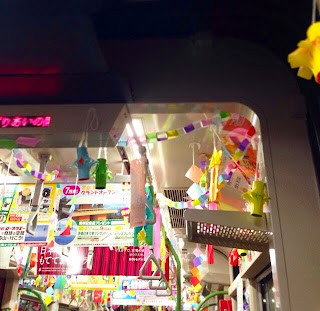
one of the newest trains, the piccola/piccolo series, decorates the outside for things like christmas, valentines day, and tanabata (summer star festival). for tanabata, they even go so far as to decorate the inside too, with stars and origami bamboo, along with wishes written by local kindergarteners. hmm...guess i should explain tanabata too, huh? it's the story of a girl (orihime) and boy (hikoboshi). orihime is a weaver, and she is very skilled at her job, i mean, she's crazy about weaving. hikoboshi is a farmer, and he's rather diligent as well. the two fall in love and get married and are indeed, very happy. however, orihime starts to loose her passion for weaving -- in fact, she stops altogether. her father gets angry about this and breaks up the happy couple, allowing them to meet only once a year (july 7).
this once-a-year meeting is even recreated using streetcars (there's a hikoboshi piccolo and an orihime piccola) -- the two cars "meet" at the atomic bomb dome station every summer. the event is held every year for the city's kindergarteners, who help to decorate the inside of the cars. little events like these just make it fun to live in hiroshima -- plus you get to see a different side of your everyday streetcars.
below are some examples of streetcars in hiroshima -- note: i don't own these pictures, i'm just borrowing them from the web.


these are one of the best ways to get around the city -- i don't know what i'd do without them!
hiroshima is a city of romen densha, or streetcars.
in fact, it's one of the few remaining cities with streetcars, as well as having the widest network. the trains run from hiroshima station, all the way out to miyajima, and branching out in all four directions.
the streetcars are run by hiroshima dentetsu, affectionately referred to as "hiroden" -- the hiroshima electric train company. there are 26 different types of streetcars, many of them older and retired streetcars from other cities that have been fixed up by hiroshima, that run on 9 different lines. it costs a flat-fare of 160 yen (for adults -- that's about $1.60), so no matter where you ride, the price doesn't change. convenient, right? for those who don't like fumbling for change, they have an IC card called PASPY that you can charge with up to 20,000 yen (or $200) and then just touch and go. you can also use PASPY on buses run by hiroden too!
plus trains usually come by at least every 10 minutes, and most stops will let you know the estimated arrival time of the next train, or at least which train is coming next.
these trains are essential for people like me who a) don't have a license, b) can't afford a car AND a parking spot in the city, c) want to lower their carbon footprint (my carbon footprint must be non-existent at this point). it's also a major mode of transportation for the morning and evening commute, not to mention for tourists, since it runs right up alongside of the peace memorial park and atomic dome site.
one of the newest trains, the piccola/piccolo series, decorates the outside for things like christmas, valentines day, and tanabata (summer star festival). for tanabata, they even go so far as to decorate the inside too, with stars and origami bamboo, along with wishes written by local kindergarteners. hmm...guess i should explain tanabata too, huh? it's the story of a girl (orihime) and boy (hikoboshi). orihime is a weaver, and she is very skilled at her job, i mean, she's crazy about weaving. hikoboshi is a farmer, and he's rather diligent as well. the two fall in love and get married and are indeed, very happy. however, orihime starts to loose her passion for weaving -- in fact, she stops altogether. her father gets angry about this and breaks up the happy couple, allowing them to meet only once a year (july 7).
this once-a-year meeting is even recreated using streetcars (there's a hikoboshi piccolo and an orihime piccola) -- the two cars "meet" at the atomic bomb dome station every summer. the event is held every year for the city's kindergarteners, who help to decorate the inside of the cars. little events like these just make it fun to live in hiroshima -- plus you get to see a different side of your everyday streetcars.

↑↑↑ decorated for tanabata ↑↑↑
below are some examples of streetcars in hiroshima -- note: i don't own these pictures, i'm just borrowing them from the web.
these are one of the best ways to get around the city -- i don't know what i'd do without them!
登録:
投稿 (Atom)