happy monday!
typhoon 18 is causing havoc across the kantou area (which includes tokyo) but not to worry! hiroshima only got some rain and occasional gusty wind. hiroshima really misses all the weird weather it seems -- much like maryland actually. but that's not what i'm here to talk about today. today is all about sashi-ire.
so, sashi-ire (sa-shee-ee-ray) is basically something that someone brings for you. so like say i'm going to a friend's house, then i would bring her something sorta as a way of saying thanks for having me over. the "something" is usually food (snacks, sweets, etc) but it can also be drinks, magazines, comics -- most anything. so like when our friends were revamping their restaurant (by hand), we brought them energy drinks as sashi-ire.
i kinda feel like being a foreigner entails you to slightly more sashi-ire than your usual japanese guy/girl -- i get stuff from people i haven't even met before. okay, wait, that sounds really sketchy. lemme rephrase. so i'm on instagram, and some of my followers live in hiroshima and they'll come to my store for the first time, usually with some kinda cookie-type thing. i haven't met them before per say, but we've "met" on instagram -- yeah, that doesn't make it less sketchy, but they're all like 20-30 year old women so... less sketchy? i dunno. anyway!
sashi-ire is one of those omotenashi things they do here -- omotenashi basically means being a good host or visitor. and hey, everyone loves free food, right?
P.S. i totally got some sashi-ire today, which reminded me to write a blog about it. the sashi-ire came from the mother of a (former) regular customer who came by for the first time in like...a year today, with his mom and dad in tow. the mother was so super sweet -- actually, the whole family was. anyway, when they get up to pay the bill, the mother hands me a small bag with these guy inside:
score! odango from my beloved momiji-an! from left to right, mitarashi (sugar, soy sauce, good stuff), spicy peanut, and isobe (soy sauce-dipped with seaweed on top -- i LOVE isobe). odango are made of rice flour and water, rolled into balls, and then boiled until chewy and soft before they roast them. if you're lucky to get one freshly roasted, they're AMAZING. not that they're horrible if they've been sitting around -- they're still awesome, but oh man, freshly roasted odango are like getting a freshly baked pizza, y'know, with the cheese still bubbling and stuff? heaven.
2014年10月6日月曜日
2014年9月7日日曜日
review: fall wagashi (or momiji-an never fails)
it's becoming more fall-ish everyday.
the humidity is less oppressive, the cicadas have finally stopped their incessant chirping, and the stores are filled chestnut and sweet potato flavoured snacks galore.
it's 食欲の秋 (shokuyoku no aki) -- loosely put, "fall is for food!" and you can bet i'm making the most of it by going to my very favorite local wagashi-ya, momiji-an!
let's have a look at their fall line-up: kuri daifuku, tsukimi ohagi, aonori ohagi.
kuri daifuku 【栗大福】 chestnut daifuku
a small, rounded daifuku made of soft mochi with a chestnut (boiled) and koshi-an inside. usually you see these with a sickeningly yellow chestnut inside (kanro-ni -- basically they boil chestnuts in sugar and likely add yellow food colouring) but not so with momiji-an. they give you the chestnut almost as is -- boiled until fluffy and slightly sweet. these guys only come out once a year, and you can bet i'll be back for more.
tsukimi ohagi 【月見おはぎ】moon-viewing ohagi
tomorrow is actually the traditional day for moon-viewing -- it's always held in september when the full moon is its brightest. it's more an excuse nowadays to eat tsukimi dango (moon-viewing dango, little rounded balls of rice flour or mochi) and drink, but i digress. this ohagi is mochi rice wrapped in sweet potato paste (see? it kinda looks like a glowing full moon!) the sweet potato is so smooth and creamy with a great natural sweetness to it. to contrast, the mochi rice inside is slightly salty to balance it all out.
aonori ohagi 【青海苔おはぎ】 green seaweed ohagi
okay, i was skeptical. i mean, look at it! it's frickkin' green! but being a HUGE fan of aonori, i couldn't pass it up. tsubu-an wrapped in mochi rice, rolled in fluffly aonori -- the aroma of the aonori hits you first -- it's...hard to describe how it smells. but it's kinda of like the green grass smell that green tea has, but with a salty tang. that salty tang works so well with the thick sweetness of the tsubu-an inside and i'm in love with this ohagi at first bite. aonori is usually used on more savory things (okonomiyaki, yakisoba, takoyaki...basically if it has sauce on it, it's usually got aonori), so i was surprised at how well it worked with sweet things too.
the humidity is less oppressive, the cicadas have finally stopped their incessant chirping, and the stores are filled chestnut and sweet potato flavoured snacks galore.
it's 食欲の秋 (shokuyoku no aki) -- loosely put, "fall is for food!" and you can bet i'm making the most of it by going to my very favorite local wagashi-ya, momiji-an!
let's have a look at their fall line-up: kuri daifuku, tsukimi ohagi, aonori ohagi.
kuri daifuku 【栗大福】 chestnut daifuku
a small, rounded daifuku made of soft mochi with a chestnut (boiled) and koshi-an inside. usually you see these with a sickeningly yellow chestnut inside (kanro-ni -- basically they boil chestnuts in sugar and likely add yellow food colouring) but not so with momiji-an. they give you the chestnut almost as is -- boiled until fluffy and slightly sweet. these guys only come out once a year, and you can bet i'll be back for more.
tsukimi ohagi 【月見おはぎ】moon-viewing ohagi
tomorrow is actually the traditional day for moon-viewing -- it's always held in september when the full moon is its brightest. it's more an excuse nowadays to eat tsukimi dango (moon-viewing dango, little rounded balls of rice flour or mochi) and drink, but i digress. this ohagi is mochi rice wrapped in sweet potato paste (see? it kinda looks like a glowing full moon!) the sweet potato is so smooth and creamy with a great natural sweetness to it. to contrast, the mochi rice inside is slightly salty to balance it all out.
aonori ohagi 【青海苔おはぎ】 green seaweed ohagi
okay, i was skeptical. i mean, look at it! it's frickkin' green! but being a HUGE fan of aonori, i couldn't pass it up. tsubu-an wrapped in mochi rice, rolled in fluffly aonori -- the aroma of the aonori hits you first -- it's...hard to describe how it smells. but it's kinda of like the green grass smell that green tea has, but with a salty tang. that salty tang works so well with the thick sweetness of the tsubu-an inside and i'm in love with this ohagi at first bite. aonori is usually used on more savory things (okonomiyaki, yakisoba, takoyaki...basically if it has sauce on it, it's usually got aonori), so i was surprised at how well it worked with sweet things too.
2014年9月4日木曜日
wagashi: kuromame daifuku, zunda-mochi, mizu-manju
wagashi 【和菓子】 "japanese sweets"
i love wagashi.
i'm also fortunate enough to have a rather esteemed wagashi-ya (japanese sweets shop) about 20 seconds away -- momiji-an (もみじ庵).
while popular in japan, it's not likely that you see them all that often in the US (esp. not in MD). it's a shame too, since they're really, really good. there are many different kinds too, but this entry will be focused on just three: kuromame daifuku, zunda-mochi, and mizu-manju (don't worry, there will be more blogs on wagashi to come).
kuromame daifuku 【黒豆大福】
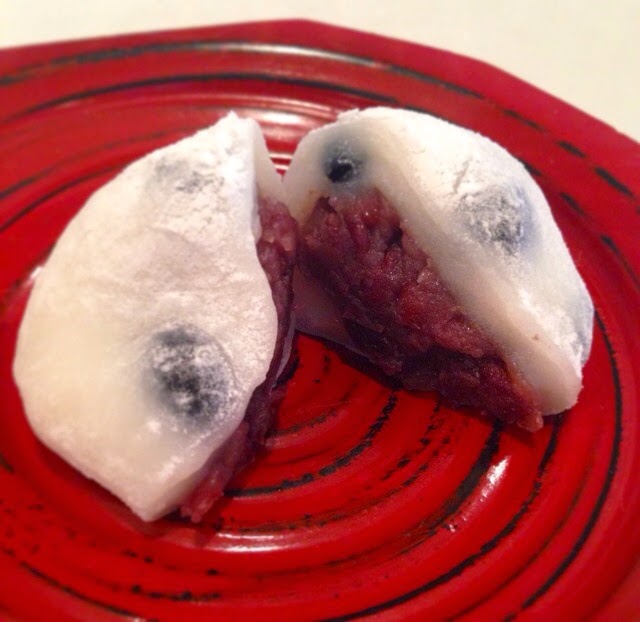
kuromame, or black soybeans, are large black-skinned soy beans. the beans are cooked but they're rather firm in texture, and are slightly salty. the beans are mixed into mochi (pounded glutinous rice) and then the mochi is wrapped around a ball of anko (sweetened red bean paste).
momiji-an makes all of their wagashi at their store, so it's fresh when you buy it. this means that the mochi is so, so soft and so, so chewy -- it's like biting into a cloud. the hard kuromame give the soft mochi a great texture, and the salt too brings out the subtle sweetness of the anko. i have to admit, i wasn't a fan the first time i tried kuromame daifuku, but that was because i bought one of those mass-produced ones they sell at the konbini. fresh made daifuku and mass-produced daifuku are two completely separate things -- and it was love at first bite with momiji-an.
zunda-mochi 【ずんだ餅】
green, eh? hmm...green tea?
wrong.
it's actually edamame. you know, green soybeans?
...i know, i was wary too! so wary, in fact, that this was actually my first time eating it!
zunda is a paste of ground edamame mixed with sugar (i KNOW, i know...). the paste is then wrapped around mochi and voila! zunda-mochi.
it actually doesn't taste all that different than regular anko, if not a little buttery (like salted edamame, who'da thought?) and it works well -- surprisingly well. the two azuki (red beans) on the top add a dash of sweetness too. there's no end to the magic that beans can do for sweets it seems.
mizu-manju 【水まんじゅう】
okay let's be honest here -- i'm not a huge fan of jelly-like things. and this is a very jelly-like thing. to be specific, it's kuzuko, which is a type of starch made from kudzu or arrowroot. the starch thickens and turns into a wiggly jelly when cooled, which makes it ideal as a refreshing treat on a hot day, if you're into that kinda thing. the kuzuko jelly is wrapped around anko and served chilled on its own, or sometimes served in a bowl of icy water, and is also known as kuzu-manju.
kuzu itself doesn't have a taste per-say, it just tastes kinda...plant-y? has...medicinal tones? it's VERY subtle, whatever it is, but all i know is that i don't like it in large doses. unfortunately, this is a rather large dose.
the anko is phenomenal -- a lightly sweetened koshi-an that's just as smooth as the kuzu jelly. the whole thing goes down easy, and hey, i'll admit, it is kinda refreshing. i just can't get around the large percentage that is not anko.
while it may not be my cup of tea, it could very well be yours. if you're a fan of things like jell-o, then you'll probably really like mizu-manju. as for me, i'll stick with shaved ice in the summer.
i love wagashi.
i'm also fortunate enough to have a rather esteemed wagashi-ya (japanese sweets shop) about 20 seconds away -- momiji-an (もみじ庵).
while popular in japan, it's not likely that you see them all that often in the US (esp. not in MD). it's a shame too, since they're really, really good. there are many different kinds too, but this entry will be focused on just three: kuromame daifuku, zunda-mochi, and mizu-manju (don't worry, there will be more blogs on wagashi to come).
kuromame daifuku 【黒豆大福】
kuromame, or black soybeans, are large black-skinned soy beans. the beans are cooked but they're rather firm in texture, and are slightly salty. the beans are mixed into mochi (pounded glutinous rice) and then the mochi is wrapped around a ball of anko (sweetened red bean paste).
momiji-an makes all of their wagashi at their store, so it's fresh when you buy it. this means that the mochi is so, so soft and so, so chewy -- it's like biting into a cloud. the hard kuromame give the soft mochi a great texture, and the salt too brings out the subtle sweetness of the anko. i have to admit, i wasn't a fan the first time i tried kuromame daifuku, but that was because i bought one of those mass-produced ones they sell at the konbini. fresh made daifuku and mass-produced daifuku are two completely separate things -- and it was love at first bite with momiji-an.
zunda-mochi 【ずんだ餅】
green, eh? hmm...green tea?
wrong.
it's actually edamame. you know, green soybeans?
...i know, i was wary too! so wary, in fact, that this was actually my first time eating it!
zunda is a paste of ground edamame mixed with sugar (i KNOW, i know...). the paste is then wrapped around mochi and voila! zunda-mochi.
it actually doesn't taste all that different than regular anko, if not a little buttery (like salted edamame, who'da thought?) and it works well -- surprisingly well. the two azuki (red beans) on the top add a dash of sweetness too. there's no end to the magic that beans can do for sweets it seems.
mizu-manju 【水まんじゅう】
okay let's be honest here -- i'm not a huge fan of jelly-like things. and this is a very jelly-like thing. to be specific, it's kuzuko, which is a type of starch made from kudzu or arrowroot. the starch thickens and turns into a wiggly jelly when cooled, which makes it ideal as a refreshing treat on a hot day, if you're into that kinda thing. the kuzuko jelly is wrapped around anko and served chilled on its own, or sometimes served in a bowl of icy water, and is also known as kuzu-manju.
kuzu itself doesn't have a taste per-say, it just tastes kinda...plant-y? has...medicinal tones? it's VERY subtle, whatever it is, but all i know is that i don't like it in large doses. unfortunately, this is a rather large dose.
the anko is phenomenal -- a lightly sweetened koshi-an that's just as smooth as the kuzu jelly. the whole thing goes down easy, and hey, i'll admit, it is kinda refreshing. i just can't get around the large percentage that is not anko.
while it may not be my cup of tea, it could very well be yours. if you're a fan of things like jell-o, then you'll probably really like mizu-manju. as for me, i'll stick with shaved ice in the summer.
2014年8月20日水曜日
review: momiji-an summer wagashi line-up
momiji-an is a delightful little wagashi-ya in sakai-machi (naka-ku, hiroshima city). after undergoing a major renovation in may, the small, but well-known japanese confectionary has launched quite a few new wagashi standards, as well as new limited edition summer wagashi.
i tried two new ohagi (tomato, roasted corn, respectively), as well as the annual pione daifuku.
first, ohagi.
for those unfamiliar with these little guys, ohagi is chewy mochi rice ("glutinous rice" -- what?), wrapped in anko, a lightly sweetened red bean paste (smooth or chunky, depending on preference). it can also be the opposite --- anko wrapped in mochi rice. either way, these rounded treats are have just the right amount of sweet and salty and, of course, go great with tea.
which brings me to the first summer ohagi -- tomato ohagi.
i know, tomato?! what? how does that -- no, no ---
trust me, i know. i was skeptical too. the light red colouring, the little shiso leaf for a stem.
okay, it's adorable, i'm not gonna lie.
but how does it taste?
surprisingly good. it's like they mixed tomato juice into the shiro-an (white anko made of white beans) that surrounds the mochi rice. it's got just the right amount of tomato flavor and salt to make it more a snack than a dessert. tomato lovers will definitely dig the fresh tomato flavour too.
next we move on to (brace yourself) roasted corn ohagi.
this one is an example of mochi rice surrounding anko variety --- kernels of roased corn, lightly buttered and seasoned with soy sauce dot the surface of the mochi rice with a chunky anko (tsubu-an) center. i'll be honest, i was really, really skeptical anout this one until i finally took a bite.
it's crazy how well these ingediants go together. the saltiness of the corn brings out the sweetness of the anko and the chewy mochi rice goes great with texture of roast corn. who'da thought, right?
last we have the annual summer favorite, pione daifuku.
pione, pronounced pee-oh-nay, is a brand of grapes grown in miyoshi city (nothern part of hiroshima prefecture). these dark purple (and very expensive) grapes are often given as gifts and are very, very sweet.
daifuku, for those unaware, are little rounds of anko wrapped in pounded mochi rice (a.k.a mochi).
put the two together and you get one large pione grape wrapped in lightly sweeted smooth anko (koshi-an) wrapped again in mochi. the soft and chewy mochi goes great with the juicy pione center, and the koshi-an does a great job bringing them both together.
if you're in the mood for some non-traditional wagashi, then i would definitely recommend these summer confections!
登録:
投稿 (Atom)